• The Haunted Championship Run

    They told me football was supposed to be loud. They told me it had to be bigger every year, brighter every season, faster with every update. More graphics. More spectacle. More chaos. As if the only way for something to matter was for it to shout.

    But that is not why I built this series.

    I built it for the quiet nights. For the glow of a CRT monitor in a dim room. For the soft hum of a machine working faithfully in the corner while the rest of the world moves too fast outside the window. I built it for the feeling of sitting down after a long day, exhaling, and letting the pace of life slow down instead of speed up. This haunted football league, filled with Wraiths, Revenants, Frost Wights, and Phantoms, is not meant to overwhelm anyone. It is meant to welcome them.

    At first glance, naming a team Bob Saget feels absurd. It sounds like a punchline, something tossed into the mix for the sake of humor. But there is something honest about it. Something personal. When you send a team named Bob Saget onto the field against the Winnipeg Frost Wights, it feels like an inside joke shared between you and the universe. It feels human. And then, as the season unfolds, something unexpected happens. The joke fades. The team becomes real. The games tighten. The standings begin to matter. The absurd name becomes stitched into a legitimate championship run.
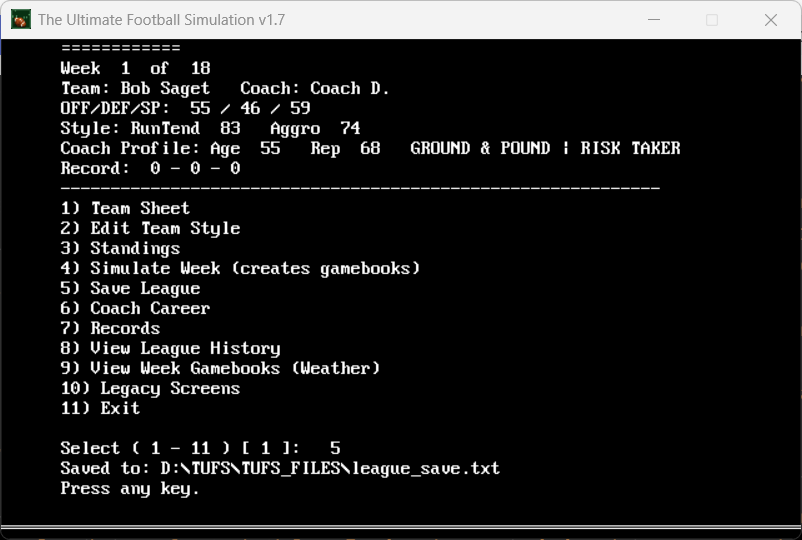
    That is where the magic lives.

    This series is not about winning quickly. It is about watching something grow. It is about the slow burn of a schedule. It is about noticing how momentum builds over weeks rather than moments. When Salem lines up against Sleepy Hollow, or when Winnipeg’s cold efficiency carries them through December, the story does not announce itself with fireworks. It creeps in quietly. You feel it in the standings. You feel it when a late-season game suddenly matters more than you expected. You lean forward just a little more. You care just a little more. And before long, you are invested.

    There was a time when sports magazines would print bold predictions before the first snap of the year. They would introduce teams like legends waiting to be born. That is the feeling this series chases. It feels like flipping through a 1991 football preview issue, pages filled with confidence and imagination. Only now, you are not reading about the season. You are living it. You are guiding Bob Saget through cold nights and tight games. You are watching the playoff picture sharpen week by week. The championship does not explode onto the screen. It approaches gradually, like a horizon coming into focus.

    That is why the invitation is simple. Find a quiet corner. Turn down the lights. Let the noise fade. This is not meant to compete with spectacle. It is meant to replace it, if only for a little while. There is no rush here. No pressure. No obligation to keep up with anything beyond the next snap and the next week on the schedule. It is football reduced to its most comforting form: numbers, strategy, rivalry, and story.

    And beneath the ghosts and the playful team names, there is structure. There is competition. There is the honest pursuit of a championship. The haunted aesthetic gives the league personality, but the heart of it remains pure. A team rises or falls based on what happens across a season. A narrative forms not because it was scripted, but because it was earned. That is where the connection happens. That is where something digital begins to feel tangible.

    They say games must constantly evolve. Perhaps sometimes evolution means remembering what mattered in the first place. A standings screen that tells a story. A recap that reads like a closing chapter. A franchise that feels like yours because you watched it struggle and push forward. This series is not chasing television realism. It is chasing imagination. It is chasing the quiet joy of watching something unfold naturally over time.

    In the end, this is my love letter to anyone who wants to have fun and cut loose without noise or pretense. To anyone who misses when games felt personal. To anyone who remembers sitting alone with a machine and feeling like they had discovered something quietly powerful. The Bob Saget championship run is not trying to outshine the world. It is trying to outlast it. Season by season. Episode by episode.

    So find your corner. Let the room settle. Let the ghosts take the field. And watch as a team with a ridiculous name fights its way through frost and shadow toward something real. Because sometimes the greatest pleasure is not spectacle or noise, but simply sitting back and enjoying a game of football.
  • Subscribe, what do you got to lose?

    Sunday has a certain smell to it when you grow up the right way. Today it’s a roast in the oven, slow and patient, filling the house with something warm and familiar. It’s Super Bowl Sunday apparently. The television will tell you that it matters. The noise outside will try to convince you that it matters. Crowds yelling, people drunk by mid-afternoon, everyone pretending they’re analysts, coaches, and prophets for a few loud hours. I never cared much for that. I still don’t. What I care about is the feeling that Sundays used to have before everything needed to be an event.

    There was a time when Sunday meant quiet focus. The weather would start turning kind, spring creeping in without permission, and summer sitting just around the corner. You could feel it in the air. Windows open. No rush. No obligation to scream at a screen. Just time. I would move between systems, NES, Genesis, then eventually the PC, not chasing spectacle but sinking into games that asked something of you. Games that wanted attention. Games that respected patience. Games that didn’t shout back.

    That’s the space this league lives in.

    My kind of Sunday.

    While others are drowning in noise, there’s something deeply calming about sitting down with a simulation that doesn’t care about hype. Numbers don’t yell. Stats don’t exaggerate. Records don’t lie. When you love numbers, really love them, there’s a kind of peace that comes from watching systems unfold naturally. Seasons progress. Careers rise and fall. Teams evolve. Nothing flashy. Nothing fake. Just logic, probability, and history quietly stacking on top of itself.

    That roast smell pulls me back to those Sundays. Sitting alone, controller or keyboard in hand, fully absorbed. No commentary. No ads. No crowd noise. Just the hum of the machine and your own thoughts keeping you company. That’s what unwinding actually feels like. Not distraction, but focus. Not escape, but immersion. The kind where an hour disappears and you don’t even notice.

    This league isn’t about replacing Sunday traditions. It’s about reclaiming them. About choosing calm over chaos. Thought over volume. Depth over spectacle. If today means something to you because of the Super Bowl, that’s fine. Enjoy it your way. But if you’re like me, if you’d rather let the world be loud while you stay quiet, if you’d rather explore numbers than noise, then you already understand what makes this special.

    Some Sundays are meant for shouting. Others are meant for thinking. I know which ones I prefer.


  • a reflection on fictional teams, fake coaches, and why this matters

    There is a moment, usually late at night, when you stop thinking about features and start thinking about meaning.

    It happens when the code finally compiles. When the screen redraws correctly. When the season advances without crashing. And suddenly you are no longer fixing bugs, you are staring at a plain text file and realizing that this file is the league.

    A text file.

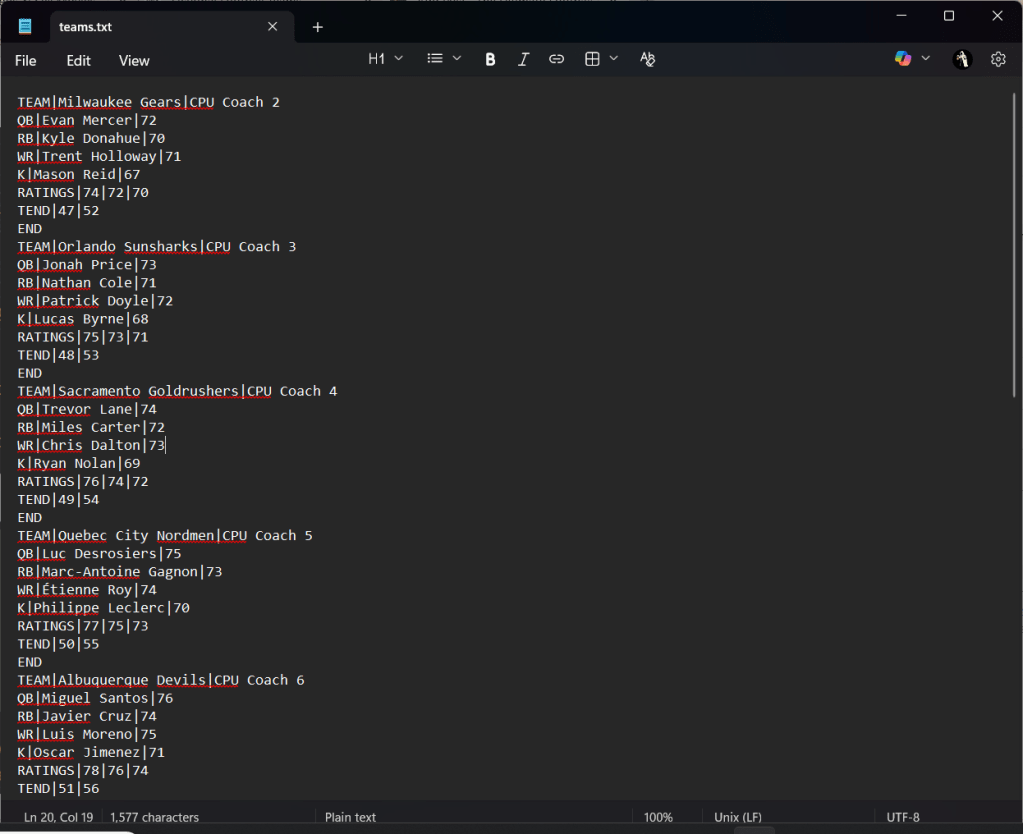
    In this game, the entire football universe lives inside a document that looks unremarkable at first glance. Lines separated by pipes. Uppercase labels. Numbers that do not shout for attention. It is not flashy, and that is exactly the point.

    The teams file is where the league is born.

    Each team begins with a single declaration. A name, a city, a coach. That is it. No licensing. No trademarks. No baggage. These are places that feel real, but belong entirely to the game. Cities you recognize, teams you do not. Vancouver Ironclads. Halifax Mariners. Boise Stallions. Providence Nightjacks. Names that sound like they could have existed, or maybe should have.

    This is deliberate.

    A non-licensed game does not pretend to be reality. It creates its own. These teams are not copies of anything you already know. They are invitations. They ask you to imagine who they are, what their history might be, and how they came to exist in this league at all.

    Right after the team line comes the coach.

    Not a real person. Not a celebrity. Just a name. Plain. Functional. Believable. The kind of name you would see printed in a newspaper box score in 1989 and never think twice about. And yet, that name matters. Because once seasons pass, that coach is no longer just a label. They are the person who went 3–13 and somehow kept their job. Or the one who built a quiet dynasty without fanfare. Or the coach who never quite figured it out.

    The game remembers them because the file remembers them.

    Then come the players.

    Best team in the league.

    Quarterback. Running back. Wide receiver. Kicker.

    Nothing more than that, and nothing less. This is not a roster bloated with detail for detail’s sake. This is a distilled version of football. A reminder that at its core, the sport is a few roles interacting with probabilities and decisions. Each player has a name that sounds like someone you could have gone to school with, worked with, or read about in a box score thirty years ago.

    They are not stars. They are not legends yet.

    They have to earn that.

    The ratings follow, quietly. Three numbers. No explanation needed. You already know what they represent. Strengths, weaknesses, balance. These numbers are not promises, they are tendencies. A strong team on paper can still collapse. A mediocre team can still catch lightning in a bottle. The file does not dictate the story. It only sets the conditions.

    And then there is the line that might be the most important one.

    Tendencies.

    This is where the teams stop being symmetrical. Where personality sneaks in. Where one team leans aggressive and another plays it safe. These numbers are subtle, but over time they shape everything. How games feel. How seasons unfold. Why certain teams always seem to lose the same way, and why others always find themselves in close contests.

    Nothing in this file is wasted. Every line exists for a reason.

    And when the file ends, it does not feel like the end of a document. It feels like the beginning of a season. Or a decade. Or a league history that has not been written yet but will be, one simulation at a time.

    This approach is intentional. It is rooted in the same philosophy that guided early sports simulations. Back when storage was limited, interfaces were simple, and imagination did most of the heavy lifting. The game does not overwhelm you with presentation. It trusts you. It trusts that you will project meaning onto these names and numbers. That you will remember the Ironclads as more than a line of text. That you will care when a coach retires or a team finally breaks through.

    Modern games often hide their leagues behind layers of abstraction. Databases you never see. Systems you cannot touch. This game does the opposite. It shows you the bones. It lets you open the file, read it, understand it, and even change it if you want to. There is something honest about that.

    The league is not sacred. It is editable. And because of that, it feels alive.

    At the end of the day, this is not just about football. It is about how worlds are built. About how something as simple as a text file can carry history, personality, and memory. About how constraints force creativity. And about how a game does not need official names or flashy assets to feel real.

    Sometimes all it needs is a few cities, some made-up teams, a handful of coaches, and the quiet promise that whatever happens next will be remembered.

    Line by line.

  • Long before polygon counts and motion capture, sports games lived and died by their math. UFS is built in that tradition.

    At the lowest level, every play, drive, and game outcome is resolved through layered probability systems rather than deterministic scripting. Team ratings are not outcomes. They are weighted inputs into a calculation loop that evaluates advantage, resistance, and variance on every possession.

    Offense and defense ratings interact multiplicatively, not absolutely. A strong offense increases the probability ceiling of successful drives, while a strong defense compresses that range. The result is not a binary win check, but a shifting probability curve that changes week to week.

    Coaching tendencies matter. Aggression values bias play selection toward higher-risk outcomes. Conservative teams trade ceiling for consistency. These values do not flip switches. They skew distributions.

    Randomness exists, but it is bounded. All random rolls operate within constrained ranges defined by team quality, season context, and situational modifiers. This prevents chaos while preserving uncertainty. Upsets happen, but only when the math allows them to happen.

    Seasonal continuity is where the system reveals itself. Over many iterations, the law of large numbers takes over. Strong teams trend upward. Weak teams struggle. But no season is identical, because inputs subtly change every year. Fatigue, regression, progression, and accumulated history all alter the math space going forward.

    There are no rubber-band mechanics. No comeback boosts. No cinematic interference. Just calculations resolving again and again, quietly accumulating truth. This is the same philosophy that powered early football simulations on systems with less memory than a modern icon file. Back then, the challenge was not rendering players. It was deciding what should happen.

    UFS embraces that constraint. Numbers do not decorate the game. They are the game. And if you play long enough, you stop seeing stats. You start seeing patterns. Dynasties emerge. Collapses make sense. Legends are not declared. They are calculated. That is the math of UFS. Simple enough to run fast. Deep enough to last decades.

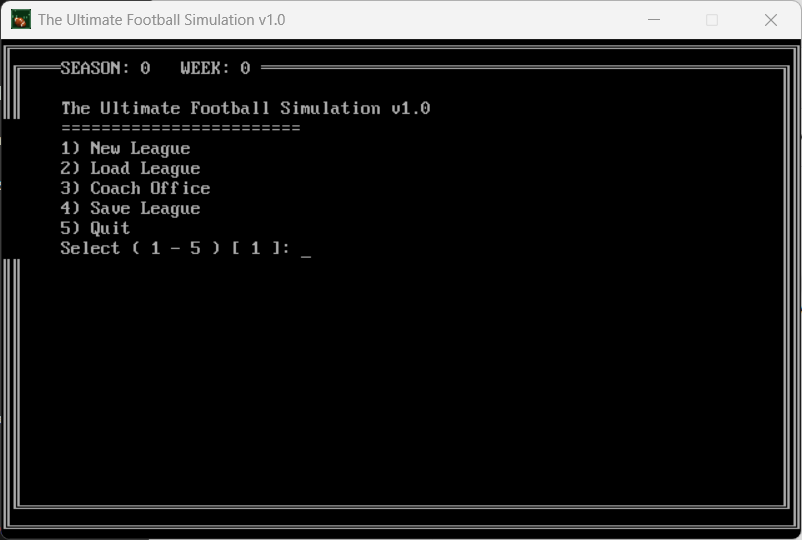
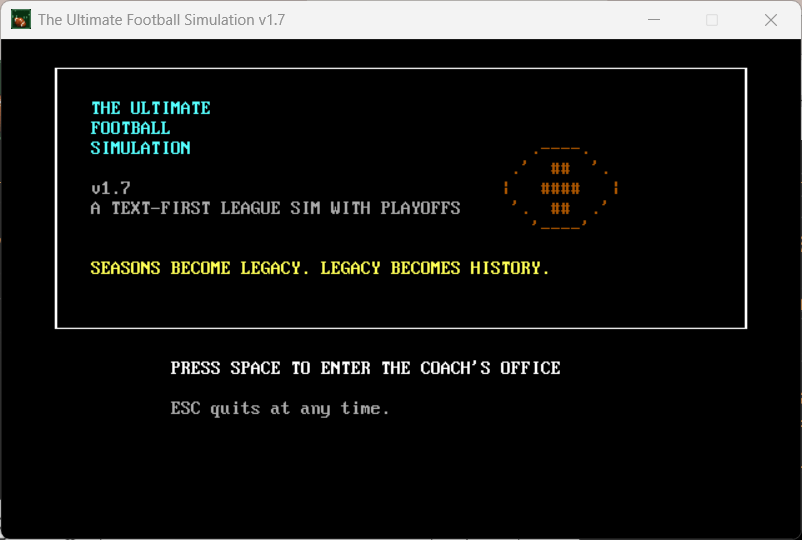
  • This first look pulls back the curtain on a football game built with a different mindset. No flash, no gimmicks, no modern distractions. Just pure football logic, stats, seasons, and decision-making, inspired by the old DOS and early PC sports sims that let your imagination do the heavy lifting.

    In the video, you’ll see the foundation of the game in action: managing teams, tracking records, progressing through seasons, and watching the league evolve over time. It’s a slower, more thoughtful kind of football experience, the kind you sink into after a long day just to unwind and let the numbers tell the story.

    This is only the beginning. More features, deeper realism, playoffs, history tracking, and long-term league progression are all on the way. This first video is simply an invitation to step inside and see where it all starts.

    If you love retro sports sims, old-school PC vibes, and football stripped down to its core, this one’s for you.

    Stay tuned. The season is just getting started. 🏈

    +
  • I remember the first time I encountered the BASIC programming language. It was equal parts fascination and fear. On one hand, it felt approachable, almost friendly. On the other, it carried the quiet realization that with enough patience, you could make a computer do just about anything. There was a sense of unlimited possibility sitting there on the screen, waiting for instructions.

    Around that same period, while reading Creative Computing, I came across a description of a program that would quietly change how I thought about games. The Dartmouth Football Game. It wasn’t flashy. It wasn’t graphical. It was a football simulation told entirely through text, from the coach’s perspective. You made decisions, the program calculated outcomes, and the season unfolded one game at a time. For me, that was perfect. That was the moment I fell in love with simulations.

    This might sound strange coming from a football simulation designer, but I am not a sports fan in the traditional sense. I like the sport itself, but I have never enjoyed the surrounding experience. The parking, the crowds, the scramble for seats, the constant noise, the shouting, the bathrooms, and the slow escape from the parking lot afterward. None of it holds any appeal. If anything, it gets in the way.

    What does interest me are the systems underneath. The numbers. The probabilities. The long-term story that emerges over the course of a season. Text-only sports simulations remove everything extraneous and leave behind the structure. You are not watching football. You are running it.

    That is where the fun has always been for me.

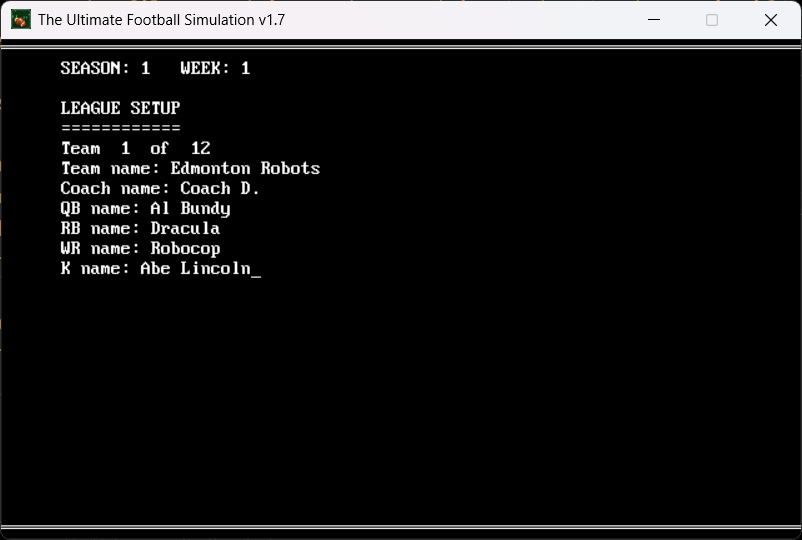
    This project exists for people who feel the same way. It is football without the spectacle. An 18-game season played out in text. A full playoff structure. A record-keeping system that remembers what happened and carries it forward. Everything is written to files you can inspect yourself. Nothing is hidden. Not bad for a program written in BASIC.

    The goal was never to compete with modern sports games. It was to build something quieter, more thoughtful, and more enduring. A league with 12 teams, all named by the user, populated with players you define. A game you can sit down with, think through, and return to when you feel like it.

    I grew up playing Atari Football on an Atari Jr., and later discovering text-based sports simulators that trusted the player’s imagination. This league is built in that same spirit. It is for anyone who enjoys the idea of football more than the noise surrounding it, and for anyone who believes a game can still live comfortably inside a block of text.

    With that, welcome to
    THE ULTIMATE FOOTBALL SIMULATION LEAGUE.

    +