• So let me tell you about today.

    It wasn’t supposed to be some big breakthrough day. It was just another sit down, open up the code, take a look at things, fix what needs fixing kind of session. The kind I’ve had dozens of times working on this football simulator. Quiet progress. Small wins. Nothing flashy.

    But something shifted.

    For a while now, the game has worked. You can simulate seasons, track standings, see results. It does everything a football sim should do on paper. But if I’m being honest, it always felt like it was missing something. Like I was watching numbers move around instead of watching football happen.

    And that’s the thing about these kinds of games. They can function perfectly and still feel empty.

    Today was the day that changed.

    We introduced players in a real way. Not just placeholders, not just numbers tied to a team, but actual pieces inside the system that influence what happens on the field. Quarterbacks, running backs, receivers. Suddenly teams weren’t just names on a list anymore. They started to feel like collections of people, even if it’s all text on a screen.

    Then came injuries.

    And this is where I really started to feel it.

    Not just players disappearing for a few weeks, but players staying in, playing hurt, not quite themselves. That small detail added something I didn’t even realize was missing. It created tension. It created uncertainty. You start to wonder if your team can hold on, or if things are about to fall apart.

    We added staff too. Training and medical quality. It’s subtle, almost invisible when you first look at it, but over time you start to notice the difference. Some teams stay strong. Some teams fall apart. It’s not random anymore. It’s layered.

    And then the trades.

    Real movement. Players changing teams and actually staying there. Not a visual trick, not a temporary swap. A real shift in the league. The kind of thing that makes you stop and think, “Okay… that might change everything.”

    That’s when it hit me.

    I wasn’t just fixing code anymore.

    I was watching something start to live on its own.

    There were moments today where I just sat back and let the game run. No debugging. No tweaking. Just watching. And for the first time, I didn’t fully know what was going to happen next. That’s a weird feeling when you’re the one who built it.

    But that’s also the goal.

    That’s the feeling I remember from older games. The ones that didn’t need graphics to pull you in. The ones where the systems underneath were strong enough to carry everything.

    That’s what I’ve been chasing with this.

    And today, for the first time, I feel like I’m actually getting there.

    Phase 1, Step 3 is done. The foundation is solid, but more importantly, it’s starting to feel alive. There’s weight to what happens now. There’s consequence. There’s story.

    Tomorrow, we move into coaching and gameplans. That’s where things shift from just watching to actually influencing the outcome.

    But tonight, I’m just going to let it run.

    Because for the first time, it feels like I’m not just playing a simulation.

    I’m watching a league unfold.
  • Season 6: When Chaos Became the Identity of the League

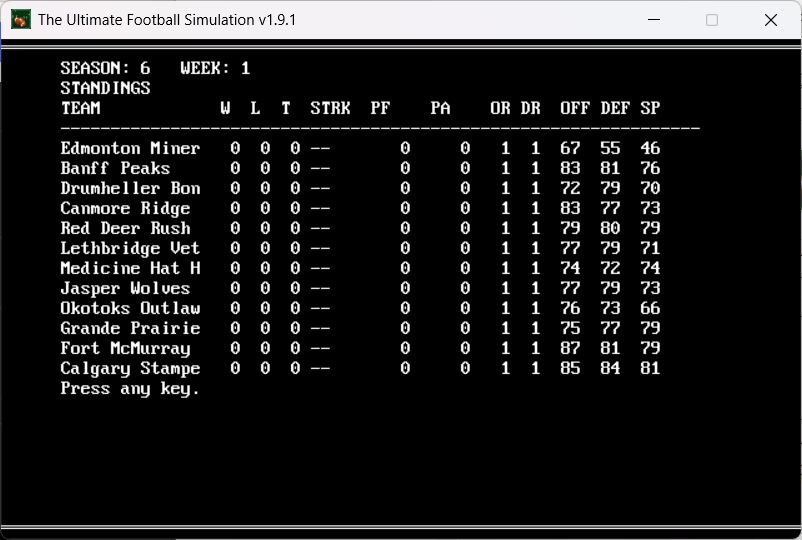
    Season 6 of the UFS League stands as one of the most volatile and emotionally charged campaigns in its history, a season that defied prediction at nearly every turn and ultimately reshaped how the league is understood. What began as a standard simulation quickly evolved into something far more unpredictable, where momentum was fleeting, dominance was temporary, and every week carried the weight of reinvention.

    From the opening week, the tone was established with a level of intensity that hinted at the instability to come. The Edmonton Miners’ 42–32 victory over Calgary was not simply a win, but a declaration that no team intended to ease into the season. At the same time, high-scoring clashes such as Canmore Ridge’s 47–44 triumph over Okotoks revealed a league already teetering on the edge of chaos. These early results suggested that traditional expectations, whether rooted in past performance or perceived strength, would hold little value moving forward.

    As the season progressed into its early weeks, patterns failed to emerge. Teams that appeared dominant one week faltered the next. Banff Peaks showcased explosive potential, highlighted by their remarkable 57–24 victory over Calgary in Week 6, a performance that suggested the arrival of a powerhouse. Yet this dominance proved unsustainable, as inconsistency became the defining trait not just of Banff, but of nearly every team in the league. Similarly, the Edmonton Miners remained competitive without ever fully asserting control, embodying a kind of quiet persistence that contrasted sharply with the league’s more dramatic fluctuations.

    The middle portion of the season further emphasized this unpredictability. Offensive explosions were followed by sudden collapses, and decisive victories were often offset by unexpected defeats. Canmore Ridge’s 55-point performance in Week 11 demonstrated the heights teams could reach, while Grande Prairie North’s 44–8 dismantling of Drumheller underscored the league’s capacity for lopsided outcomes. However, these moments of dominance rarely translated into sustained success. Instead, they contributed to a broader sense that no team could maintain control for long, reinforcing the idea that Season 6 was governed less by hierarchy and more by circumstance.

    As the season entered its final stretch, the chaos did not dissipate but instead began to crystallize. Teams that had struggled to find consistency started to surge, while others faltered under the increasing pressure. Lethbridge Vets emerged as a late contender, and Red Deer Rush delivered one of the season’s most explosive performances with a 54-point outburst in Week 16. These late-season developments added further complexity to an already unpredictable standings picture, ensuring that the playoff race remained uncertain until the final weeks.

    The postseason, however, marked a decisive shift in tone. Where the regular season had been defined by volatility, the playoffs revealed clarity. Okotoks Outlaws advanced with authority, defeating Jasper in the wildcard round, while Medicine Hat Heat signaled their emergence as a true contender with a commanding 40–22 victory over Fort McMurray. In the semifinals, both teams continued their ascent, setting the stage for a championship matchup that contrasted sharply with the chaos that preceded it.

    In the final, Medicine Hat Heat delivered a performance defined by control and composure, defeating Okotoks 35–16 to secure the championship. Unlike many games throughout the season, the outcome was decisive and unmistakable, reflecting a team that had not only survived the league’s unpredictability but had ultimately mastered it. Their victory served as a resolution to a season otherwise characterized by disorder, demonstrating that while chaos may dominate, it can still yield to preparation and execution at the highest level.

    In retrospect, Season 6 is best understood not as a traditional competition, but as a transformative period in the league’s evolution. It challenged assumptions about consistency, exposed the fragility of dominance, and emphasized the importance of adaptability. More than any statistical record or championship result, its legacy lies in the way it redefined the nature of competition within the UFS League.

    Ultimately, Season 6 will be remembered as the year in which anything could happen, and often did. It was a season where control was temporary, momentum was elusive, and every outcome carried the potential to reshape the narrative. In that sense, its unpredictability was not a flaw, but its defining strength, a reminder that the essence of sport lies not in certainty, but in the endless possibility of the unexpected.

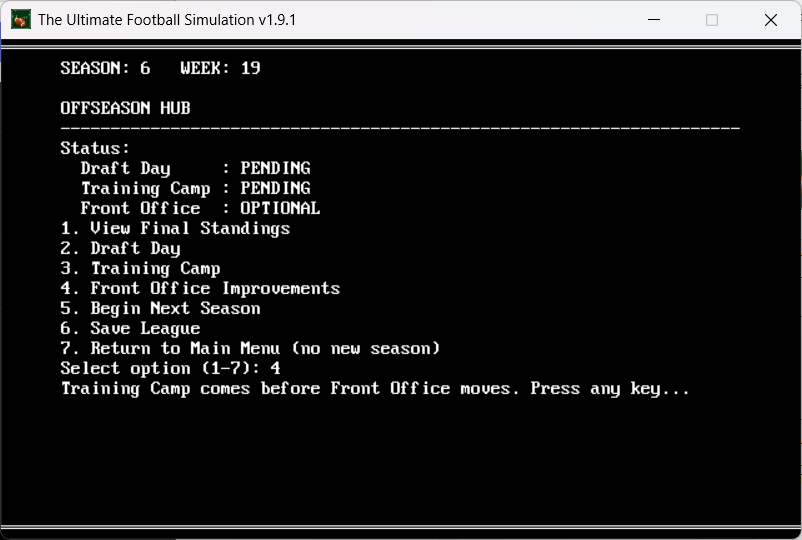
  • The jump from v1.8 to v1.9.1 wasn’t about adding noise. It was about restoring trust in the machine. v1.8 had the bones of something special. The structure was there, the seasons flowed, the numbers were alive. But beneath it all, there were cracks. Save files didn’t always come back the way they were written. Standings could drift into strange territory. Weeks sometimes pushed past where they were meant to exist. It was playable, but not yet dependable.

    v1.9.1 is where that changed.

    This version went deep into the foundation and tightened everything that holds the league together. Save and load now speak the same language, so what you build is exactly what you get back. The standings screen has been stabilized so every stat, every record, every ranking reflects the truth of the season without corruption. The weekly simulation flow has been locked in, preventing out-of-range errors and eliminating those moments where the season would step beyond its own limits. Even the headlines system has been reinforced so that every week carries its own narrative without risking a crash.

    What that means in practice is simple, but powerful. You can now sit down, run week after week, and trust what you’re seeing. The numbers hold. The league remembers. The simulation doesn’t fight itself anymore.

    And that changes everything.

    Because once the system is stable, the numbers start to matter in a different way. A win feels earned. A loss lingers. A season begins to take shape not as a collection of outputs, but as something closer to history. That was always the ambition. v1.9.1 is the version where that ambition finally has a solid ground to stand on.

  • There are seasons that pass quietly through the memory of a league.

    And then there are seasons like this one.

    Season 5 of The Ultimate Football Simulation was not just played, it was felt. It was written in cold Alberta nights, in scorelines that swung wildly between dominance and desperation, in teams that rose, fell, and clawed their way back into relevance. It was, in every sense, a season that reminded us why we build these worlds in the first place.

    From the opening whistle, it was clear this would not be a year of balance. Calgary Stamped came out like a machine possessed, dropping 55 points in Week 1 against Edmonton and setting the tone early . It wasn’t just a win, it was a statement. And yet, like all great seasons, the story refused to stay simple.

    Because just beneath Calgary’s dominance, chaos was brewing.

    Banff Peaks carved out their place as a relentless force, stacking wins with quiet authority. Canmore Ridge emerged as one of the most dangerous teams in the league, capable of dismantling opponents with precision. Medicine Hat Heat burned hot and unpredictable, a team that could just as easily collapse as they could explode for 40-plus on any given week.

    And then there were the Wolves of Jasper.

    Unforgiving. Physical. Persistent.

    They never felt like the best team on paper, but week after week they found ways to win the games that mattered, grinding out victories and surviving battles that would have broken lesser teams. By the time the playoffs arrived, you could feel it in the numbers and in the rhythm of the results. They belonged.

    But Season 5 was not just about who rose.

    It was about who endured.

    Edmonton Miners fought through a brutal schedule, flashes of brilliance buried under inconsistency. Fort McMurray Oil delivered both crushing wins and frustrating losses, a team constantly on the edge of something greater. Red Deer Rush, Okotoks Outlaws, Drumheller Bones. Each carried their own narrative, their own stretch of weeks where it felt like everything might finally come together.

    And sometimes, for a moment, it did.

    That’s the beauty of this kind of game. Not every team is destined for a title, but every team gets its moment.

    By the time the regular season closed, the standings weren’t just numbers. They were stories. Every point for and against, every narrow loss, every blowout win. All of it leading to a postseason that felt inevitable in hindsight, but impossible to predict in the moment.

    The playoffs delivered exactly what the season had promised.

    Medicine Hat Heat surged when it mattered most, pushing through the Wild Card and dismantling Canmore Ridge in the semifinal. Jasper Wolves, battered but unbroken, fought their way past Edmonton only to run headfirst into the force that had defined the season.

    Calgary Stamped.

    And in the final, there was no doubt left.

    A 33 to 20 victory over Medicine Hat sealed it . Not just a championship, but the culmination of a season where they had carried the weight of expectation from the very beginning and never let it slip.

    This was not luck.

    This was identity.

    If there is such a thing as an era beginning, it feels like it started here.

    But beyond the champion, beyond the numbers, beyond the standings screen you’ve refined so carefully, there is something else that matters more.

    This season felt alive.

    Not because of graphics. Not because of presentation tricks. But because every result, every stat line, every week built on the last. The league remembered. The teams evolved. The story wrote itself, one line at a time.

    And somewhere in all of that, between the code and the chaos, between the wins and the losses, you can feel it.

    This is why we play.

    This is why we build.

    Because sometimes, in a simple text file filled with scores and names, you don’t just see a season.

    You see something real.

  • The Early Season: Chaos Wearing a Scoreboard

    Right out of the gate, nothing made sense.

    Watch the madness unfold.

    The Pasted text logs tell the story in cold numbers, but if you were watching closely, you could feel it unraveling.

    • Calgary Stamped came out swinging, dropping 40 on Edmonton in Week 1
    • Canmore Ridge absolutely obliterated Okotoks 46–6 like it meant something deeper
    • Red Deer and Jasper traded blows in a one-point knife fight

    This wasn’t structure. This was noise. Controlled chaos.

    And in that chaos, a few teams started whispering:

    We might be something this year.


    Midseason: The League Splits in Two

    By Weeks 6 through 12, the UFS stopped being unpredictable… and started being merciless.

    • Red Deer Rush began stacking wins like they were building a case for history
    • Banff Peaks turned into a quiet executioner, dropping 30+ without ceremony
    • Grande Prairie North played like a machine, efficient and cold

    And then there were the Wolves.

    At first, Jasper didn’t scream dominance. They grew into it.
    A 33–19 win over Banff.
    A dismantling of Fort McMurray.
    Then that moment… that shift.

    Week 16:
    Jasper Wolves 44 – Edmonton Miners 11

    That wasn’t just a win.

    That was a message.


    The Collapse and the Surge

    While some teams rose, others… faded.

    Edmonton Miners, once a name with weight, became a weekly casualty.
    Okotoks flashed brilliance, then vanished just as quickly.
    Calgary, dangerous early, began to feel… mortal.

    And through it all, Jasper didn’t just win.

    They stabilized.

    No panic. No wild swings. Just execution.

    Like a team that already knew where this season was going.


    The Playoffs: Where Identity Becomes Truth

    This is where UFS always hits different.

    Because the regular season builds the illusion.
    The playoffs decide what was real.

    And this year?

    It got violent.

    • Jasper Wolves dropped 60 on Calgary in the Wild Card
    • Medicine Hat carved through Edmonton like it was inevitable
    • Okotoks, one of the season’s most volatile teams, got shut down when it mattered most

    And then…

    The Final.

    Jasper Wolves vs Medicine Hat Heat.

    A clash between momentum and firepower.


    The Championship: 31–29

    No blowout. No runaway ending.

    Just football.

    Just tension.

    Just two teams trading everything they had left in the tank.

    And when it ended…

    Jasper Wolves 31 – Medicine Hat Heat 29

    Two points.

    That’s all that separated legacy from almost.


    The Legacy of Season 4

    This wasn’t just another season in your simulation.

    This was the moment where your league stopped being numbers… and started becoming history.

    • Jasper Wolves didn’t just win. They announced an era
    • Medicine Hat proved they belong in every future conversation
    • Red Deer, Banff, and Grande Prairie built the kind of pressure that defines future seasons

    And maybe most importantly…

    This season felt like something pulled straight out of a 1997 sports magazine, printed on slightly yellowed paper, read late at night under a dim lamp.

    Because at the end of the day, this isn’t just code.

    It’s not just a sim.

    It’s that feeling of sitting in front of an old machine, watching seasons unfold, knowing that somehow… through text and imagination…

    You built something that matters.

  • There are seasons you simulate.

    And then there are seasons you feel.

    Watch the game here.

    Season 3 of the UFS League was not just another collection of numbers scrolling across a DOS-style screen. It was 18 weeks of tension, upsets, wild swings in momentum, and the quiet poetry that only a text-based football universe can produce.

    It began simply enough. Week 1 opened with Calgary edging Edmonton 23–20, a three-point warning shot that this year would be measured in inches. Grande Prairie North throttled Drumheller 30–15. Medicine Hat stumbled. The Wolves howled early.

    But if you watched closely, the signs were there.

    Drumheller Bones were building something.


    The Middle Stretch: Chaos as Identity

    By Week 4 the league had already fractured into contenders and pretenders.

    Grande Prairie North showed power, dropping 37 on Jasper. Fort McMurray Oil kept grinding out wins with disciplined, balanced offense. Calgary could explode for 46 one week and collapse the next.

    Then came the volatility.

    Week 6:
    Medicine Hat 41, Edmonton 19
    Fort McMurray 39, Drumheller 23

    Week 8:
    Jasper Wolves 52, Banff Peaks 21
    Okotoks 38, Calgary 18

    Week 9:
    Lethbridge Vets 51, Banff Peaks 9

    Fifty-one points. In a text-based league. In a system where every yard and every touchdown is born from pure simulation logic. There is something deeply satisfying about watching a number like 51 appear on a monochrome scoreboard. No flashy graphics. No commentary team. Just pure, cold dominance.

    And that’s when you realize why this format matters.

    The imagination fills the rest.


    The Oil, The Wolves, The Vets

    Fort McMurray Oil were methodical. Not flashy. Not chaotic. Just efficient. They controlled pace. They forced mistakes. They made the playoffs look inevitable.

    Jasper Wolves? Electric. Fifty-two in Week 8. Forty-nine in Week 16. They could detonate an opponent’s defensive identity in three simulated quarters.

    Lethbridge Vets were the quiet assassins. Physical. Capable of 48 in Week 11. Capable of grinding 23–23 stalemates. They were the kind of team that wins in December.

    But through it all, Drumheller Bones kept evolving.

    They weren’t always spectacular. They were steady. They absorbed losses early. They sharpened in the middle. They learned how to close.

    Week 13:
    Drumheller 29, Jasper 19.

    Week 14:
    Drumheller 33, Lethbridge 23.

    Week 18:
    Drumheller 29, Okotoks 32 — a narrow loss that felt like a rehearsal.

    You could feel it. The system was converging.


    The Playoffs: Where Identity Becomes Legacy

    Wildcard Round:
    Fort McMurray Oil 41, Lethbridge 21
    Drumheller Bones 17, Okotoks 12

    That 17–12 win was not glamorous. It was not loud. It was surgical.

    Semifinals:
    Drumheller 20, Edmonton 14
    Fort McMurray 25, Red Deer 19

    And then, the final.

    PO-F:
    Drumheller Bones 24
    Fort McMurray Oil 17

    A seven-point championship. Not a blowout. Not luck. Not chaos.

    A controlled victory.

    In a league built on numbers and logic, the Bones did what great franchises do. They tightened when the stakes rose. They didn’t need 50. They needed 24.

    And that was enough.

  • By Someone Who Definitely Meant to Just Watch One Game

    There are seasons that unfold logically.

    And then there is whatever just happened in the Alberta League.

    Season Two began the way all seasons begin: with optimism, spreadsheets, and the quiet belief that maybe this year we would all behave like professionals. That lasted approximately one quarter.

    Opening week set the tone. Calgary Stamped dismantled Edmonton, 40–9, like a team that had already read the ending. Banff Peaks hung 53 on Fort McMurray, which is not so much a victory as a statement. And then, like an omen whispered politely, Lethbridge and Medicine Hat tied at 29. A draw. In football. Which is the sporting equivalent of a handshake agreement to revisit your emotional issues later.

    By Week 3, Grande Prairie North was thumping Edmonton again, Jasper Wolves were slipping past Calgary by a single point, and Fort McMurray was losing by margins so small you could measure them with a sigh.

    And here’s the thing about this league: nobody stayed consistent long enough to get comfortable.

    Calgary dropped 53 on Lethbridge in Week 4. Medicine Hat answered with a 42–16 dismantling of Okotoks in Week 5. Red Deer Rush scored 53 in Week 6 as if someone accidentally turned the difficulty setting to “arcade mode.”

    Meanwhile, Jasper Wolves quietly kept winning. Not loudly. Not dramatically. Just enough. A 41–17 statement over Grande Prairie. A 36–16 dismantling of Fort McMurray. A 33–25 reminder in Canmore. The Wolves did not dominate the headlines. They simply kept appearing in the win column like a polite but persistent dinner guest.

    By midseason, you could make a case for half the league. Banff Peaks exploded some weeks and evaporated others. Calgary oscillated between juggernaut and question mark. Edmonton, bless them, tried. Medicine Hat Heat simmered early, then began to boil.

    And if this sounds chaotic, that’s because it was.

    Week 12 saw Calgary edge Edmonton 41–37 in a game that felt like two quarterbacks arguing in math class. Week 13 delivered a 40–0 Calgary demolition of Grande Prairie, followed by Medicine Hat quietly stacking another win.

    By Week 16 and 17, everything tightened. One-score games. Defensive slugfests. The kind of football where you lean forward on the couch and forget to breathe because a field goal might alter history.

    And then came the playoffs.

    Lethbridge bowed out first, 12–6 to Calgary, in a game that felt like winter. Jasper Wolves dispatched Grande Prairie, 32–13, then slipped past Drumheller 32–27 in a semifinal that could have been decided by a stiff breeze.

    Calgary then ran into Medicine Hat.

    And this is where the story changes tone.

    Because Medicine Hat Heat had been warming all year. Not flashy. Not reckless. Just consistent. Balanced. Calm. The kind of team that knows the oven temperature and doesn’t panic when the timer beeps.

    They edged Calgary 38–33 in a semifinal that felt like a coin flip.

    Then the final.

    Jasper Wolves, 12.
    Medicine Hat Heat, 18.

    No fireworks. No absurd stat lines. Just composure.

    And that’s the part I love.

    Because for 18 weeks, the Alberta League was chaos. Fifty-point explosions. Tie games. One-point heartbreaks. Teams reinventing themselves in mid-October like they were changing hairstyles.

    But in the end, the champion wasn’t the loudest team.

    It was the steadiest.

    Medicine Hat Heat did not win the season in Week 1. They did not win it in Week 9. They won it by surviving it.

    Which, if you think about it, is the most 1997 lesson imaginable.

    In a league where every Sunday felt like someone spilled coffee on the playbook, the Heat kept their hands steady.

    And somewhere, probably on a perfectly respectable sectional couch, a fan sat back, exhaled, and thought:

    You know what? That was a good season.

    Even if it made absolutely no sense.

    Watch the season for yourself!
  • So let me tell you about my day.

    I had this grand plan. I was going to surprise my wife with a four day romantic weekend. No kids. No interruptions. Just the two of us. Candlelight. Relaxation. Maybe even one of those breakfasts where you use actual plates instead of paper towels.

    And let me tell you something. Planning that surprise? About as successful as convincing the entire internet to download my football simulation game in one glorious overnight viral explosion.

    Because guess what showed up instead?

    The head cold bug.

    Not just a polite little sniffle either. No no. The full “we live here now” kind of cold. The kind that cancels romance but insists on staying for soup.

    So the big romantic weekend turned into tissues, tea, and strategically placed cough drops. But honestly? We were together. The kids were home. It was Family Day. And in a weird way, that’s kind of perfect.

    And here’s the thing about unexpected downtime. It gives your brain room to wander. Mine wandered straight back to the game.

    You know how sometimes when you’re sick you just want comfort food? Well, for me, that’s late 80s, early 90s shareware vibes. So I leaned in.

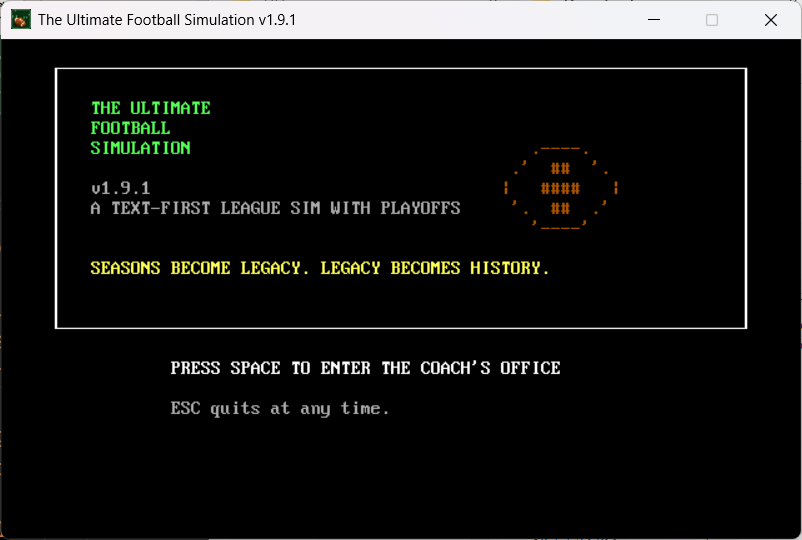
    I changed the boot sequence so it feels like you’re loading it off a dusty disk you found in a beige box under your desk. That little whistle sound in BASIC when it fires up? Chef’s kiss. That’s nostalgia hitting you right in the floppy drive.

    Then I built a new title screen.

    And I’m not going to lie, I’m kind of proud of it. There’s something about designing a retro title like it’s running on a 386 that feels sacred. Like you’re summoning a time when computers cost as much as a used car and you still waited patiently for them to do anything.

    And the crowd cheer?

    That did it.

    When you press a key and the crowd erupts, it feels like you’re stepping into something alive. Like this weird little text-based world actually matters. Like somewhere, in some parallel universe, thousands of pixelated fans are losing their minds over a fictional championship.

    That’s the vibe I’m chasing.

    I’ve got plans too. Big ones. Expanding from 12 teams to maybe 24. An Alberta league showdown. Snow games. Prairie rivalries. The whole thing. Imagine battling for a world title in a text-based football universe that feels like it came from a $2 shareware disk.

    And honestly? Being able to post about it. Make videos. Share updates. Have you wonderful people actually read this and care?

    That makes it worth it.

    Sometimes I imagine a future where people are huddled around their computers again. Maybe one day there’s even a LAN party version. Can you imagine? Old school competitions. Trash talk. Laughter. Pure fun. No microtransactions. No battle passes. Just bragging rights.

    That would be pretty sweet.

    I think that’s really why I made this game. Not to chase trends. Not to compete with the mega studios. But to reclaim that party feeling. That magic of old text-based sports games. The ones you discovered by accident and played until midnight because you just had to simulate one more week.

    And the fact that you’re along for the ride?

    Well.

    That makes this whole thing feel like a win already.

  • Today, The Ultimate Football Simulation has officially been released to the public.

    It feels strange writing that. For a long time this project existed quietly on my machine, evolving season after season, being refined in small increments. It was something I would come home to, tweak, simulate another week, adjust a rating, run another playoff. It didn’t feel like a product. It felt like a league that kept living in the background.

    But as of today, it’s out there.

    You can download it here: The Ultimate Football Simulation by Just Sim It

    This game didn’t come from chasing trends or trying to compete with modern sports titles. It came from missing something. I missed when sports simulations were about structure instead of spectacle. I missed the feeling of watching a season slowly take shape through standings and numbers rather than camera angles and overlays. I missed when the long-term arc of a league mattered more than presentation.

    The Ultimate Football Simulation is a pure text dynasty engine. You don’t control players on the field. You don’t call plays in real time. You oversee a league and let it unfold. Each season runs through an 18-week schedule, then playoffs, then a championship. Coaches age. Reputations change. Teams rise and fall. The longer you let it run, the more the league develops a personality of its own.

    What I care about most is time. Not just a single season, but ten of them. Not just one championship, but what happens after three in a row. What happens when a dominant coach starts to decline. What happens when a once-great franchise collapses and spends years trying to rebuild. None of that is scripted. The engine does what it does, and patterns begin to form naturally.

    All of the teams live in plain text files. You can open them. You can change them. You can build your own version of the league if you want to. That openness matters to me. I don’t want this to feel sealed off. If you want to reshape the universe, you can.

    This release isn’t the end of anything. It’s the beginning of the league existing beyond me. If you download it and run your own seasons, your history will be different from mine. Different dynasties will form. Different collapses will happen. That’s part of the point.

    Today it leaves my machine and becomes something others can experience.

    I built it because I missed that quiet feeling of watching numbers turn into narrative. If that sounds like something you’ve missed too, then I think you’ll understand what this is trying to be.

    The league is live.

  • An Ultimate Football Simulation Season Review

    There are seasons that unfold politely. And then there are seasons that arrive like a thunderclap in a midnight graveyard.

    Season Two of the league did not ask permission.

    It began quietly enough. League saved. League loaded. Week One simulated. The machine humming, the math churning, the schedule turning like gears in an old stadium clock tower. And then the first whistle blew and the ghosts came alive.

    Roswell Grey Shades announced themselves immediately with a 44–19 demolition of Bob Saget. Winnipeg Frost Wights handled Salem. New Orleans dropped 36 on Jerome. Sleepy Hollow exploded for 49 in Tombstone. Right away, the tone was clear: this would not be a season for half-measures. Points would come in waves. Defenses would break. Legends would form.

    By Week Three, parity had already fractured.

    Salem Wraiths hung 42 on Tombstone. Roswell lit up St. Augustine. Charleston edged Winnipeg in a grinder. Bob Saget fought, but every week felt like pushing uphill against a gale force wind. The numbers did not lie. They rarely do in this league.

    Then came Week Four.

    Bob Saget 0.
    Charleston Nightwalkers 49.

    A shutout that felt like a seismic shift. That was the moment the Nightwalkers began to look less like contenders and more like inevitability.

    Across the first half of the season, we saw distinct identities emerge. Savannah Phantoms turned into a scoring machine, capable of 42 one week and 59 the next. Gettysburg Apparitions built a bruising defense that could hold teams in the teens. Winnipeg Frost Wights leaned into balance, winning ugly when needed and explosive when required. Roswell Grey Shades, perhaps the most volatile unit in the league, could score 44 on Salem one week and grind out 18 the next.

    The stat sheets told a deeper story.

    Through nine weeks, scoring variance was among the highest in league history. Blowouts and shootouts lived side by side. Week Nine alone featured Savannah putting 59 on Bob Saget and Gettysburg dropping 41 on New Orleans. Offensive efficiency climbed as defensive stamina dropped. The simulation math showed it clearly: tempo was up, possession swings were sharper, and late-game decision modifiers played a visible role in fourth-quarter outcomes.

    Week Ten through Twelve felt like the separation phase.

    New Orleans blasted Bob Saget 48–10. St. Augustine dismantled Charleston 35–7. Gettysburg answered with a 53–13 statement over the Poltergeists in Week Twelve, a performance that reverberated through the standings. Charleston counterpunched every time they were questioned. Winnipeg continued to stack disciplined wins. Savannah oscillated between brilliance and chaos.

    And then came the stretch run.

    Week Thirteen delivered a 54–27 Frost Wights statement over Bob Saget. Week Fourteen saw Jerome put up 49 on Bob Saget in a brutal display. By Week Fifteen, Savannah dropped 44 on New Orleans while Gettysburg edged Salem in a heavyweight battle.

    The playoff picture hardened like winter ground.

    Charleston Nightwalkers: physical, balanced, opportunistic.
    Savannah Phantoms: explosive, high-variance, capable of 40-plus on anyone.
    Winnipeg Frost Wights: resilient, disciplined, built for cold-weather grind.
    Gettysburg Apparitions: defensive spine, opportunistic scoring.
    Tombstone Specters: dangerous but inconsistent.
    Jerome Ghost Miners: flashes of dominance, difficulty closing.

    Week Eighteen sealed it. Winnipeg handled Roswell. St. Augustine put 40 on Savannah. Sleepy Hollow closed with 35 on Bob Saget. The regular season ended not with whispers but with a statistical roar.

    Then the playoffs began.

    Wild Card: Charleston survived Gettysburg 34–30 in a razor-thin thriller. Winnipeg suffocated Tombstone 3–20, a defensive masterclass that reminded everyone that style points do not matter in January.

    Semifinals: Savannah edged Tombstone 27–24, proving they could win tight. Charleston marched into Jerome and silenced them 26–9, a performance that felt clinical, almost surgical.

    And then the final.

    Charleston Nightwalkers 32
    Savannah Phantoms 26

    The championship game was exactly what this season deserved: heavy hits, lead changes, late tension. Savannah’s firepower met Charleston’s control. The difference came in situational execution. Red-zone efficiency. Third-down conversion rate. Turnover differential. The hidden math inside the box score.

    When the final whistle blew, the Nightwalkers stood alone.

    Not because they were the flashiest. Not because they scored the most in any single week. But because across eighteen weeks and three playoff rounds, they were the most complete.

    Season Two was not clean. It was not predictable. It was not polite.

    It was stat-driven chaos refined into order.

    It was 59-point explosions and 3-point defensive grinders. It was shutouts and 50-point avalanches. It was a league saved, loaded, and simulated into something that felt alive.

    The numbers tell the story, but the feeling tells it better.

    This was a season where the machine did not merely calculate outcomes. It created mythology.

    And at the center of it all, beneath the lights and the flicker of the scoreboard, stood the Charleston Nightwalkers.

    Champions.