a reflection on fictional teams, fake coaches, and why this matters
There is a moment, usually late at night, when you stop thinking about features and start thinking about meaning.
It happens when the code finally compiles. When the screen redraws correctly. When the season advances without crashing. And suddenly you are no longer fixing bugs, you are staring at a plain text file and realizing that this file is the league.
A text file.
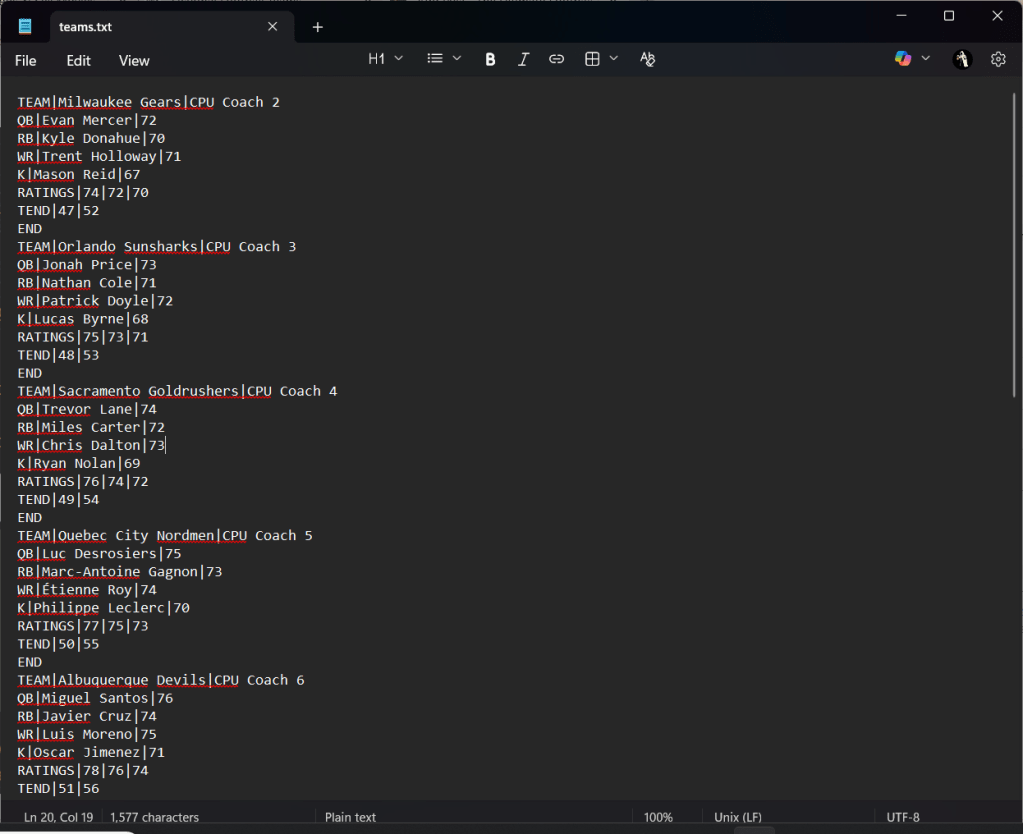
In this game, the entire football universe lives inside a document that looks unremarkable at first glance. Lines separated by pipes. Uppercase labels. Numbers that do not shout for attention. It is not flashy, and that is exactly the point.
The teams file is where the league is born.
Each team begins with a single declaration. A name, a city, a coach. That is it. No licensing. No trademarks. No baggage. These are places that feel real, but belong entirely to the game. Cities you recognize, teams you do not. Vancouver Ironclads. Halifax Mariners. Boise Stallions. Providence Nightjacks. Names that sound like they could have existed, or maybe should have.
This is deliberate.
A non-licensed game does not pretend to be reality. It creates its own. These teams are not copies of anything you already know. They are invitations. They ask you to imagine who they are, what their history might be, and how they came to exist in this league at all.
Right after the team line comes the coach.
Not a real person. Not a celebrity. Just a name. Plain. Functional. Believable. The kind of name you would see printed in a newspaper box score in 1989 and never think twice about. And yet, that name matters. Because once seasons pass, that coach is no longer just a label. They are the person who went 3–13 and somehow kept their job. Or the one who built a quiet dynasty without fanfare. Or the coach who never quite figured it out.
The game remembers them because the file remembers them.
Then come the players.
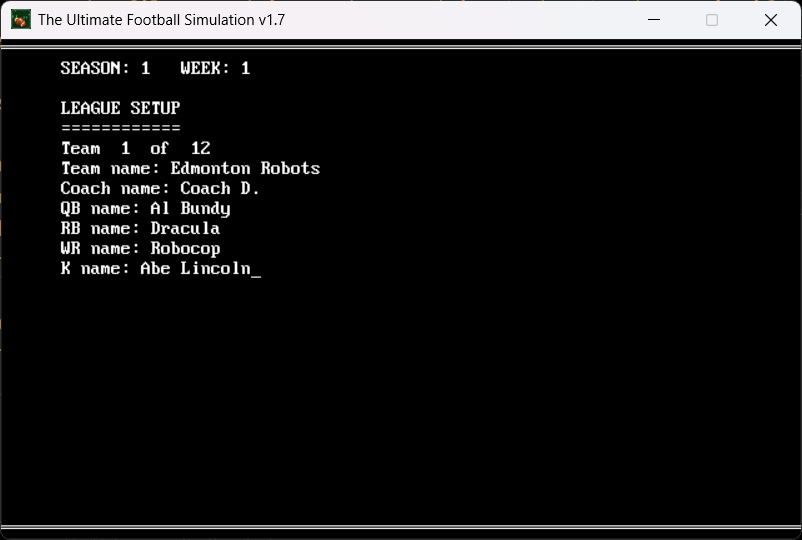
Quarterback. Running back. Wide receiver. Kicker.
Nothing more than that, and nothing less. This is not a roster bloated with detail for detail’s sake. This is a distilled version of football. A reminder that at its core, the sport is a few roles interacting with probabilities and decisions. Each player has a name that sounds like someone you could have gone to school with, worked with, or read about in a box score thirty years ago.
They are not stars. They are not legends yet.
They have to earn that.
The ratings follow, quietly. Three numbers. No explanation needed. You already know what they represent. Strengths, weaknesses, balance. These numbers are not promises, they are tendencies. A strong team on paper can still collapse. A mediocre team can still catch lightning in a bottle. The file does not dictate the story. It only sets the conditions.
And then there is the line that might be the most important one.
Tendencies.
This is where the teams stop being symmetrical. Where personality sneaks in. Where one team leans aggressive and another plays it safe. These numbers are subtle, but over time they shape everything. How games feel. How seasons unfold. Why certain teams always seem to lose the same way, and why others always find themselves in close contests.
Nothing in this file is wasted. Every line exists for a reason.
And when the file ends, it does not feel like the end of a document. It feels like the beginning of a season. Or a decade. Or a league history that has not been written yet but will be, one simulation at a time.
This approach is intentional. It is rooted in the same philosophy that guided early sports simulations. Back when storage was limited, interfaces were simple, and imagination did most of the heavy lifting. The game does not overwhelm you with presentation. It trusts you. It trusts that you will project meaning onto these names and numbers. That you will remember the Ironclads as more than a line of text. That you will care when a coach retires or a team finally breaks through.
Modern games often hide their leagues behind layers of abstraction. Databases you never see. Systems you cannot touch. This game does the opposite. It shows you the bones. It lets you open the file, read it, understand it, and even change it if you want to. There is something honest about that.
The league is not sacred. It is editable. And because of that, it feels alive.
At the end of the day, this is not just about football. It is about how worlds are built. About how something as simple as a text file can carry history, personality, and memory. About how constraints force creativity. And about how a game does not need official names or flashy assets to feel real.
Sometimes all it needs is a few cities, some made-up teams, a handful of coaches, and the quiet promise that whatever happens next will be remembered.
Line by line.
 The Ultimate Football Simulation League
Leave a comment